TM3 Free Dump Download - TM3 New Real Test
Wiki Article
BTW, DOWNLOAD part of CertkingdomPDF TM3 dumps from Cloud Storage: https://drive.google.com/open?id=1Zd9VxiXFv_qOzDugoQk6Xaz_ChCuJKC_
Do you want to obtain your certificate as quickly as possible? If you do, just choose us. You can get your downloading link within ten minutes after your payment for TM3 training materials, and you can start your learning as quickly as possible. In addition, TM3 training materials of us are high quality, and you just need to spend 48 to 72 hours on practicing, and you can pass the exam successfully. If you have any questions about the TM3 Exam Dumps, just contact us, we will give you reply as soon as possible.
We are proud that our BCS TM3 exam preparation material is one of the best in the market. You should buy our ISTQB Certified Tester Advanced Level - Test Management v3.0 (TM3) valid dumps and start preparation now because of some amazing offers. These offers are up to 1 year of Free TM3 Dumps updates, free demos of our TM3 exam product, and a full refund guarantee. What are you waiting for? Buy actual BCS TM3 now at discount and start your preparation.
TM3 New Real Test, TM3 Latest Exam Papers
Love is precious and the price of freedom is higher. Do you think that learning day and night has deprived you of your freedom? Then let Our TM3 Guide tests free you from the depths of pain. Our study material is a high-quality product launched by the CertkingdomPDF platform. And the purpose of our study material is to allow students to pass the professional qualification exams that they hope to see with the least amount of time and effort.
BCS TM3 Exam Syllabus Topics:
| Topic | Details |
|---|---|
| Topic 1 |
|
| Topic 2 |
|
| Topic 3 |
|
BCS ISTQB Certified Tester Advanced Level - Test Management v3.0 Sample Questions (Q52-Q57):
NEW QUESTION # 52
The diagram below shows an incomplete defect management process, where three states (states X, Y and Z) have yet to be named appropriately.
Which of the following labels would correctly complete the process?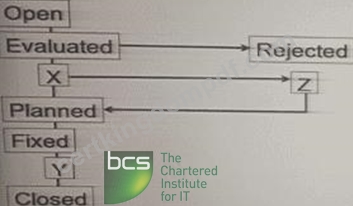
- A. X: Accepted, Y: Reviewed, Z: Duplicate.
- B. X: Accepted, Y: Tested, Z: Deferred.
- C. X: In Progress, Y: Verified, Z: Terminated.
- D. X: Approved, Y: Reviewed, Z: Deferred.
Answer: B
Explanation:
According to theISTQB Certified Tester Advanced Level - Test Manager v3.0 syllabus (Chapter 2: Test Management in the Organization), thedefect management processdefines how defects are handled from discovery to closure, ensuring traceability and communication between testing and development.
"The defect management process defines the states a defect may have during its lifetime, including identification, evaluation, correction, re-testing (confirmation testing), and closure." (ISTQB CTAL-TM v3.0 Syllabus, Chapter 2 - Defect Management Process) In the standard ISTQB defect workflow:
Afterevaluation, a defect can either be:
Rejected(e.g., not a defect, duplicate, or out of scope), or
Accepted(X) - meaning it is confirmed as a valid defect and will be corrected.
Once accepted, the defect isplannedfor correction andfixedby development.
After being fixed, it must betested (Y)- also referred to asconfirmation testingorretesting.
Some evaluated defects may bedeferred (Z)- postponed for future releases.
Thus, the correct states are:
X = Accepted(defect confirmed as valid and correction planned)
Y = Tested(confirmation testing after the fix)
Z = Deferred(postponed correction)
This sequence aligns directly with the ISTQB-defineddefect management lifecycle, which includes transitions betweenopen,evaluated,accepted (planned/fixed/tested), andclosed, as well as possiblerejectedordeferredbranches.
References (from ISTQB Certified Tester Advanced Level - Test Manager v3.0 Syllabus):
Chapter 2: Test Management in the Organization
Section:Defect Management Process
Describes thedefect states, includingopen, evaluated, accepted, planned, fixed, tested (retested), closed, and alternate states such asrejectedordeferred.
NEW QUESTION # 53
Which of the following is not a key decision when defining a project test strategy?
- A. Selection of test techniques
- B. Selection of test tools
- C. Selection of test levels
- D. Selection of test types
Answer: B
Explanation:
Comprehensive and Detailed Explanation From Exact Extract of ISTQB Certified Tester Advanced Level - Test Manager v3.0 syllabus:
In the AL Test Manager syllabus, defining the project test strategy/approach focuses onwhatto test andhowto test at a high level, which explicitly includes decisions such asthe selection of test levels,the selection of test types, andthe selection of test design techniquesas part of the approach definition and planning. Tool decisions are addressed undertest tools and automation planningand are not listed among the core strategy- defining decisions.
References: ISTQB CTAL-TM v3.0 Syllabus-Chapter 2 (Test Management in the Organization: policy
/strategy alignment and strategy content), Chapter 3 (Test Planning: test approach content including levels, types, techniques), and Chapter 6 (Test Tool and Automation: tool strategy and selection).
NEW QUESTION # 54
To which category of cost of quality does "fixing a defect found during testing" belong?
- A. Internal failure costs
- B. Appraisal costs
- C. External failure costs
- D. Defect prevention costs
Answer: A
Explanation:
Comprehensive and Detailed Explanation From Exact Extract of ISTQB Certified Tester Advanced Level - Test Manager v3.0 syllabus:
The syllabus differentiatescost of qualityinto:
Prevention(to avoid defects),
Appraisal(to evaluate products, e.g., reviews, testing),
Internal failure(defectsfound before release, including the cost to fix during testing), and External failure(defects foundafter release)."Fixing a defect found during testing" is aninternal failure cost, because the failure is detected and corrected prior to delivery (CTAL-TM v3.0, Organizational Test Management - economics of testing and cost of quality categories).
NEW QUESTION # 55
Assume that you are using traceability to manage test case coverage against test conditions. During test analysis, three test conditions were identified. Test design for system testing has been completed and 10 test cases (TC1 to TC10) have been designed, as described by the following traceability matrix ("C" indicates a critical test case, while "NC" indicates a non-critical test case):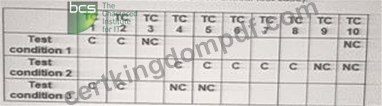
[traceability matrix not visible in the prompt]
The exit criterion for system testing states that each test condition must have all the associated critical test cases successfully executed (passed) AND all associated non-critical test cases at least executed.
The following is the situation after three days of system testing:
TC1, TC2, TC4, TC5, TC7, TC9: passed
TC3, TC10: failed (with an associated open defect report)
TC6, TC8: not run
Management wants to decide whether to release the system. You advise them that the system does not yet meet the defined exit criteria.
Based only on the given information, which test condition does not yet meet the stated exit criterion?
- A. Test condition 2
- B. Test condition 1
- C. None, all meet the stated exit criteria
- D. Test condition 3
Answer: A
Explanation:
The syllabus explicitly states thatexit criteriamust be met before considering completion of a test level:
"Exit criteria are the conditions that must be achieved to declare completion of a given test level... including coverage criteria and status of required tests (e.g., passed)."
- ISTQB CTAL-TM v3.0 Syllabus, Chapter 5Test Monitoring and Test Control And test control must act when exit criteria are not met:
"If the exit criteria are not satisfied, appropriate actions must be taken to address the situation."
- ISTQB CTAL-TM v3.0 Syllabus, Chapter 5
Sincetest condition 2 still has critical tests not yet executed, thedefined exit criteria are not fulfilled, and therefore a release decision should not be approved.
NEW QUESTION # 56
You are the only tester in an Agile team. The test policy states that only defects that need to be solved outside the team are documented. You are receiving complaints from developers from other teams that they do not receive sufficient defect information to be able to efficiently and effectively solve the defects. You have used the ISO 29119 standard to identify which attributes could be added to the current defect report template.
Which two of the following options would be best to add to the current defect report template to solve the current issue?
- A. How to reproduce the defect
- B. The name of the tester that found the defect
- C. Test level where the defect was found
- D. Severity of the defect
- E. Configuration in which the defect was found
Answer: A,E
Explanation:
Comprehensive and Detailed Explanation From Exact Extract of ISTQB Certified Tester Advanced Level - Test Manager v3.0 syllabus:
In theTesting Process(defect management and reporting), the syllabus emphasizes that defect reports must containsufficient information to allow effective reproduction and diagnosisand that they should includeenvironment/configuration detailsrelevant to reproducing the failure and isolating the underlying defect. Concretely, the syllabus highlights information such assteps to reproduce,observed and expected results, andtest environment/configurationas essential elements to enable teams (especially external teams) to analyze and fix defects efficiently. Therefore, addingHow to reproduce the defect (B)and theConfiguration in which the defect was found (E)most directly addresses the complaint of insufficient information for external developers.
(ISTQB CTAL-TM v3.0 - Chapter "Testing Process": defect reporting content and quality; importance of reproducibility and environment details in defect reports.)
NEW QUESTION # 57
......
Usually you may take months to review a professional exam, but with TM3 exam guide, you only need to spend 20-30 hours to review before the exam, and with our TM3 study materials, you will no longer need any other review materials, because our learning dumps have already included all the important test points. At the same time, TM3 Practice Engine will give you a brand-new learning method to review - let you master the knowledge in the course of the doing exercise.
TM3 New Real Test: https://www.certkingdompdf.com/TM3-latest-certkingdom-dumps.html
- TOP TM3 Free Dump Download 100% Pass | High-quality BCS ISTQB Certified Tester Advanced Level - Test Management v3.0 New Real Test Pass for sure ???? Search for ( TM3 ) on ➡ www.prepawaypdf.com ️⬅️ immediately to obtain a free download ????TM3 New Practice Materials
- Quiz Authoritative BCS - TM3 - ISTQB Certified Tester Advanced Level - Test Management v3.0 Free Dump Download ???? Search for ( TM3 ) and easily obtain a free download on ☀ www.pdfvce.com ️☀️ ????Vce TM3 Download
- TM3 Exam Labs ???? Latest TM3 Demo ???? TM3 Exam Forum ➖ Enter “ www.torrentvce.com ” and search for 「 TM3 」 to download for free ????TM3 Official Study Guide
- 100% Pass Quiz BCS - TM3 Pass-Sure Free Dump Download ???? Download [ TM3 ] for free by simply entering ➽ www.pdfvce.com ???? website ????Certification TM3 Sample Questions
- 100% Pass Quiz BCS - TM3 Pass-Sure Free Dump Download ???? Easily obtain free download of ⇛ TM3 ⇚ by searching on ⮆ www.easy4engine.com ⮄ ✴TM3 Exam Prep
- TM3 Valid Exam Materials ???? Certification TM3 Sample Questions ✴ TM3 Exam Prep ???? Search for ➥ TM3 ???? and easily obtain a free download on { www.pdfvce.com } ????TM3 Exam Forum
- Quiz Authoritative BCS - TM3 - ISTQB Certified Tester Advanced Level - Test Management v3.0 Free Dump Download ???? Search for ⏩ TM3 ⏪ and download it for free immediately on ➥ www.examdiscuss.com ???? ????New TM3 Dumps Ppt
- The Best TM3 Free Dump Download - Authoritative TM3 New Real Test Ensure You a High Passing Rate ???? Search for ▷ TM3 ◁ and download it for free immediately on 【 www.pdfvce.com 】 ????TM3 Related Content
- Valid TM3 Exam Sims ???? TM3 Exam Prep ???? Clearer TM3 Explanation ???? Easily obtain ⏩ TM3 ⏪ for free download through ⇛ www.troytecdumps.com ⇚ ????TM3 Exam Forum
- TM3 New Braindumps Pdf ✳ TM3 New Braindumps Pdf ???? TM3 Official Study Guide ???? Immediately open ➡ www.pdfvce.com ️⬅️ and search for ▶ TM3 ◀ to obtain a free download ????TM3 Related Content
- TOP TM3 Free Dump Download 100% Pass | High-quality BCS ISTQB Certified Tester Advanced Level - Test Management v3.0 New Real Test Pass for sure ???? The page for free download of ➤ TM3 ⮘ on ▛ www.prepawayexam.com ▟ will open immediately ????Latest TM3 Study Plan
- anyaynks848509.bloggerchest.com, jemimahzzd866018.daneblogger.com, youpainter.com, mysocialname.com, kingbookmark.com, robertzqfe035063.bloggip.com, www.stes.tyc.edu.tw, adrianaqoso448598.wikiworldstock.com, phoenixyorz803358.ourcodeblog.com, berthaofgg780257.bloggactif.com, Disposable vapes
P.S. Free & New TM3 dumps are available on Google Drive shared by CertkingdomPDF: https://drive.google.com/open?id=1Zd9VxiXFv_qOzDugoQk6Xaz_ChCuJKC_
Report this wiki page